buffalo sheet
- the plain Indians came from the woodlands
- in the woodlands their life was based on hunting buffalo and simple farming
- they could not life in the plains because they diffident have the tools for the hard ground
- meat :food hide: shoes other parts: shoulder blades - hoes
- it would take the Indians 15 minutes to kill a herd of buffalo
- the animals ran around in a circle of panic
- he would ride his horse between the buffalo he wanted so it woudent trample him to death
- because for the experts their is less danger and amusement and amusement of his life
- the woman skin and butcher the buffalo
- old buffalo was used for shields and winter moccasins the young buffalo was used for underclothes and tobacco pouches
aspect of life used buffalo part of buffalo used eating yes flesh, brain, nose, kidneys clothing yes clothing housing no cleaning yes fat farming yes tools hunting no entertainment no
| Sioux | Pawnee | |
| language | the Dakota, Lakota, and Nakota. | The Pawnee language is a Caddoan language spoken by some Pawnee Native Americans who now live in north-central Oklahoma. Their traditional historic lands were along the Platte River in what is now Nebraska. |
| territory | extreme east of the Dakotas, Minnesota and northern Iowa. T | most powerful tribes in the west. Although dominating the Loup and Platte river areas for centuries |
| what they looked like |  | 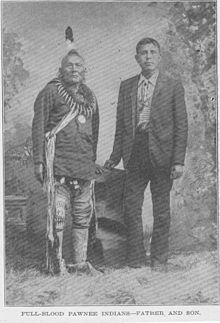 |
| clothing | ||
| tools used |
Dances With Wolves
We are watching this film because it portrays the interaction/clash between Native Americans and white European Americans in the Great Plains during the second half of the 1800's.
As you watch Dances with Wolves, please answer the
following questions in your book.
1. What type of medical care is available to soldiers during the Civil War? How does it differ for officers and enlisted men (normal soldier)?
normal soldier has no medical care only amputation
normal soldier has no medical care only amputation
2. From the end of the Civil War (1865) to the Spanish-American War (1898), the U.S. Army's primary deployment was in the Plains, fighting the "Indian Wars." What tactics did the Army use to fight against the Natives?
3. How does John Dunbar change? What is his attitude when he first creates his post?
4. What is assimilation? How does Dunbar assimilate into Sioux culture?
5. Two Native tribes are referenced in the film (Sioux and Pawnee). How do their approaches differ in dealing with whites? Which is the better approach? Why do you think so?
6. Native Americans and white European Americans view natural resources and land differently. Explain this difference, paying particular attention to the hunting/use of buffalo ("tatonka") and land ownership.
7. Predict: How will the army respond to Dunbar’s assimilation once they catch up with him?
CHARACTER
|
DESCRIBE THEIR PERSONALITY
|
WHAT THEY ARE DOING IN THE MOVIE
|
John Dunbar
| ||
Major Fambrough
|
he was a crazy drunk
|
Sends John to work at a western military outpost
|
Timmons
|
he is not nice, rude and crazy
|
he takes john Dunbar to the frontier
|
Wind in His Hair
|
Brave and angry
| |
Kicking Bird
| ||
Two-Socks
| ||
Stands With Fist
| ||
Ten Bears
| ||
Smiles a lot
|
Retrieves Dunbar’s diary
|
The film opens during the________u.s. civil war ____________. Union Army Officer Lieutenant John J. Dunbar learns that his injured leg is to be____________amputated___________. Seeing the plight of other _________soldiers__________ with amputated legs, Dunbar attempts _________suicide___________ by riding a _________horse____________ across the line of fire between the opposing ____________________ and _________________ positions. His action has the unexpected effect of rallying his comrades, who storm the Confederate positions.
After the battle, a surgeon saves Dunbar's _______leg_____. The commanding officer says that Dunbar is a ____hero______ and offers Dunbar his choice of military station.
Dunbar requests a transfer to the West Coast (frontier) of America during a quick meeting with Major Fambrough, who is having a few mental problems (he is proud that he has ____________ in his pants). Dunbar is teamed up with a rough cowboy named Timmons, who escorts Dunbar on a ______waggon_______ to his new post.
After a scenic journey, Dunbar and Timmons arrive at the isolated Fort Sedgwick, finding it deserted except for a lone ______wolf_______ that Dunbar befriends and names ________two socks ____________. Dunbar, while waiting for reinforcements to arrive, begins _______repairing_______ the deserted post. Timmons, while returning back to the East Coast of America, is ambushed by Pawnee Indians and _______scalped_______.
Timmons' death and the suicide of the major who sent him to the post prevents anyone from knowing where Dunbar is, effectively isolating Dunbar. Dunbar remains unaware of the full situation and its implications. He writes in his ________diary________ how strange it is that no more _______soldiers_______ have joined him at the post.
Dunbar has some close encounters with an aggressive tribe called the Pawnee, who steal his _______rifles_______. Dunbar decides to ride out to meet and talk with the Sioux Indians, who live in the surrounding hills.
Dunbar finds himself drawn to the _______lifestyle_______ and _____customs_________ of his Indian neighbors, the Sioux Tribe. He becomes a hero among the Sioux and is accepted as an honorary member of the tribe after he helps them locate a migrating herd of ______buffalo__________, which they depend upon as a source of ____food_______, material, and clothing.
Dunbar helps defend the settlement against a Pawnee raiding party, providing the Sioux warriors with surplus ____rifles_______ and ammunition from the fort. He eventually is accepted as a full member of the tribe, and is named Šuŋgmánitu Taŋka Ob'wačhi (literally Dances With Wolf), after they see him playing with Two Socks. He falls in love with Stands With A Fist, who initially served as an _______________ between Kicking Bird and Dunbar.The two eventually marry, and Dunbar spends more time with the tribe than manning his post at Fort Sedgwick. Dunbar's tells Kicking Bird that white men will continue to ______invade_______ their land in "numbers like the stars." They tell this to Chief Ten Bears, who decides it is time to move the village to its winter camp.
Dunbar realizes that his _____horse_________, left behind at the deserted fort, is a map for finding the Sioux. It reveals that he knows far too much about their ways. He returns to the fort to retrieve it, but finds Sedgwick is re-occupied by reinforcing Army troops, who shoot Cisco and arrest and beat Dunbar as a deserter.
Lots of other stuff happens too, but I don’t want to spoil the ending for you. Enjoy the twist in the end J

No comments:
Post a Comment
To support my learning I ask you to comment as follows:
1. Something positive - something you like about what I have shared.
2. Thoughtful - A sentence to let us know you actually read/watched or listened to what I had to say
3. Something thoughtful - how have you connected with my learning? Give me some ideas for next time or ask me a question.
Note: only a member of this blog may post a comment.